
When a Day at the Park Ends in the Emergency Room
Every parent knows the sound. A thud, a pause, and then the cry that tells you this one is different from the usual scraped knee.
Kids fall. That's part of growing up, and no one expects a playground to be padded from end to end. But there is a real difference between a child who simply tumbles and a child who gets hurt because a swing chain snapped, the mulch under the climber was worn down to packed dirt, or no one was watching the recess yard. The first is an accident. The second is often negligence, and New Jersey law gives your family a way to hold the responsible party accountable.
The numbers are sobering. U.S. emergency departments treat more than 200,000 children age 14 and under for playground injuries every year, according to the CDC. About 21,000 of those visits each year are for traumatic brain injuries, including concussions. A Consumer Product Safety Commission study found that fractures alone make up more than a third of playground injuries treated in ERs, and that 57% of these injuries happen at schools or public recreation areas — places run by people who are supposed to be keeping them safe.
This guide is written for New Jersey parents. It walks through what causes playground injuries, what negligence looks like, who can be held responsible, and the steps that protect your child's claim — including a 90-day deadline that catches many families off guard.
Our firm has a unique approach with personal injury cases, often round tabling and discussing cases with our retired Judges on staff, attorneys and paralegals. We discuss the best ways to present cases for settlement and trial. We review each case on its unique facts and give ranges of valuation.
Causes of Playground Injuries
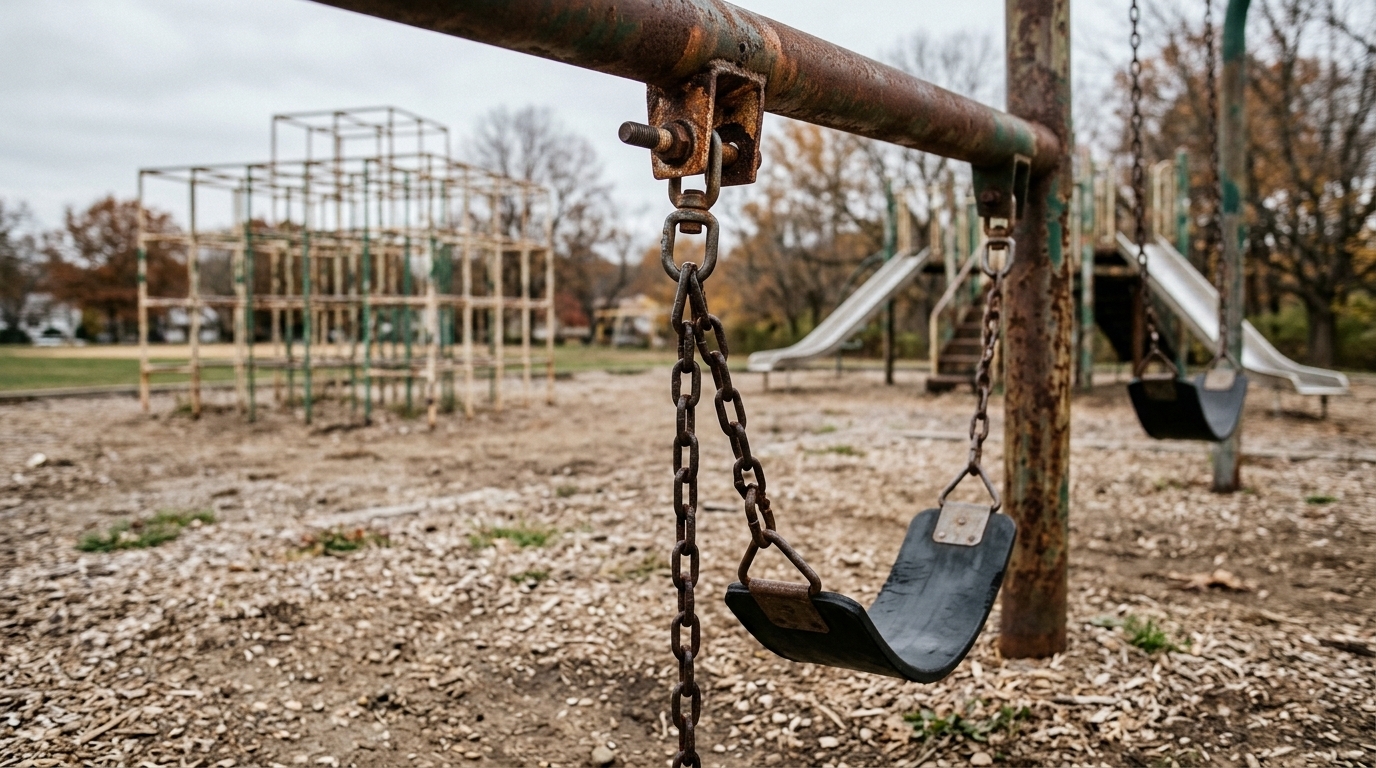
Most playground injuries come down to a handful of hazards. Federal safety officials have studied them for decades, and the same patterns show up again and again.
- Falls onto hard or worn surfacing. Falls are the single biggest cause of playground injuries. The surface under the equipment is what decides whether a fall means a bruise or a broken arm. The CPSC builds its surfacing guidance around how well a material absorbs impact. Mulch, wood chips and sand get kicked away over time, especially under swings and at the bottom of slides, leaving a thin layer over dirt or concrete.
- Broken or poorly maintained equipment. In CPSC incident reports, swings were the equipment most often involved in breakage — 72% of all reported equipment breaks. Rusted bolts, cracked plastic, frayed chains and loose hardware are maintenance failures, not bad luck.
- Entrapment and strangulation. Openings that are just the wrong size can trap a child's head or neck. Of 40 playground deaths investigated by the CPSC from 2001 to 2008, 27 were hangings or asphyxiations, many involving a rope, leash or drawstring caught on a slide or swing.
- Equipment that's too high or not age-appropriate. Climbers and monkey bars account for more ER visits than any other equipment. Toddlers on equipment built for 10-year-olds is a recipe for a serious fall.
- Sharp edges, protruding bolts and pinch points. These cause the lacerations, crushed fingers and puncture wounds that fill pediatric ERs every spring.
- Hot surfaces. Metal slides and dark rubber surfacing can cause real burns on a summer afternoon. The CPSC has documented toddlers hospitalized with burns to their hands and feet.
- Poor layout. Swings placed in a walkway, or a busy slide exit, invite collisions.
- No supervision, or the wrong kind. A packed recess yard with one distracted aide is a hazard all by itself.
Types of Negligence That Could Lead to Playground Injuries
Here's something most New Jersey parents don't know, and many law firm websites never mention: New Jersey has a mandatory playground safety code.
Under the Playground Safety Subcode, N.J.A.C. 5:23-11, the state adopted the CPSC's Public Playground Safety Handbook as binding law. It applies to playgrounds built for six or more children by government agencies, nonprofits and private businesses alike. Licensed child care centers must comply too, and must check that any community playground they take children to meets the code (N.J.A.C. 3A:52-5.3).
That matters. When a playground owner ignores a written safety standard, it's much easier to show they fell short of what a reasonable owner would have done. The most common forms of negligence we see include:
- Negligent maintenance. Letting surfacing wear thin, ignoring broken or rusted equipment, or skipping routine inspections.
- Negligent design or installation. Equipment installed without enough fall zone, at improper heights, or with the wrong surfacing for the fall height.
- Failure to repair or warn. Knowing about a hazard from such things as a complaint, an inspection, or simple common sense, but doing nothing.
- Negligent supervision. Not enough staff, distracted staff, or no one assigned at all, especially at schools, daycares and camps that take on the job of watching your child.
- Defective products. A design flaw or manufacturing defect in the equipment itself.
- Code violations. Failing to meet the state's Playground Safety Subcode or the barrier-free requirements that come with it.
Who Is Responsible? Property Owners, Manufacturers, and the Supervising Party
The first question a good playground injury attorney asks isn't "what happened?" It's "where did it happen, and who owns it?" The answer decides which rules apply, how much time you have, and what you can recover.
|
Who may be liable |
Typical examples |
What to know in New Jersey |
|---|---|---|
|
Public property owners |
Town parks, county parks, public school playgrounds, boards of education |
Governed by the NJ Tort Claims Act: 90-day notice, tougher proof, limits on pain-and-suffering damages |
|
Private property owners |
Daycares, private schools, restaurants with play areas, apartment complexes, HOAs, trampoline and indoor play centers |
Ordinary premises liability; must keep the play area reasonably safe and follow the Playground Safety Subcode |
|
Nonprofits and religious organizations |
Church playgrounds, nonprofit camps, some private schools |
May raise New Jersey's Charitable Immunity Act, which has limits and exceptions worth a lawyer's look |
|
Manufacturers, designers, installers |
Equipment makers, distributors, contractors who installed the equipment or surfacing |
Product liability for design defects, manufacturing defects or missing warnings |
|
The supervising party |
Schools, daycares, camps, after-school programs, a host family |
Liable when they took on the job of watching your child and did it carelessly |
Public playgrounds: the rules are different
Towns, counties and school districts can be sued, but only on the terms set by the New Jersey Tort Claims Act. Three rules trip up families most often:
- The 90-day notice. A formal Notice of Tort Claim generally must be served on the public entity within 90 days of the injury (N.J.S.A. 59:8-8). A phone call to the parks department or an incident report does not count.
- The dangerous-condition standard. You must show the property was in a dangerous condition, the entity knew or should have known about it, and its failure to fix it was "palpably unreasonable" — a higher bar than ordinary negligence.
- The pain-and-suffering threshold. Damages for pain and suffering require a permanent injury plus more than $3,600 in medical expenses (N.J.S.A. 59:9-2(d); NJ Model Jury Charge 8.70). Medical bills can still be recovered either way.
There's a further wrinkle on supervision. A public entity generally isn't liable for choosing not to staff a public park (N.J.S.A. 59:2-7). But a public employee who actually supervises — a recess aide, a camp counselor — can be liable for doing it negligently. And schools owe students a duty of reasonable supervision that doesn't disappear at recess.
"Where was the parent?"
Insurance adjusters love this question. Don't let it rattle you. New Jersey courts have long limited claims against parents for ordinary lapses in supervising their own children (Foldi v. Jeffries, 93 N.J. 533 (1983)). A parent glancing at a phone does not excuse a broken swing or rock-hard surfacing.
How Much Time Do You Have? New Jersey Deadlines for Child Injury Claims
The deadlines in a child's case are more complicated than in an adult's, because there are usually two claims: your child's claim for their injuries, and the parents' own claim for the medical bills they paid.
|
Claim |
General deadline |
Watch out for |
|---|---|---|
|
Child's injury claim (private defendant) |
Usually 2 years after the child turns 18 |
Evidence and witnesses disappear long before that |
|
Parents' claim for medical expenses |
Usually 2 years from the injury |
Not extended because the child is a minor |
|
Any claim against a town, county, school district or other public entity |
Notice of Tort Claim within 90 days of the injury |
Late notice is allowed only by court order, in limited circumstances, within one year |
The safest rule is the simplest: if a public playground or school is involved, treat 90 days as a hard wall. And whoever owns the playground, call a lawyer while the scene still looks the way it did the day your child got hurt. Mulch gets raked, swings get replaced, and surveillance video gets recorded over in days.
New Jersey also uses modified comparative negligence. A child is judged against what a child of the same age and experience would do, not an adult. Very young children are rarely found at fault at all.
Helping Your Child's Case After an Accident
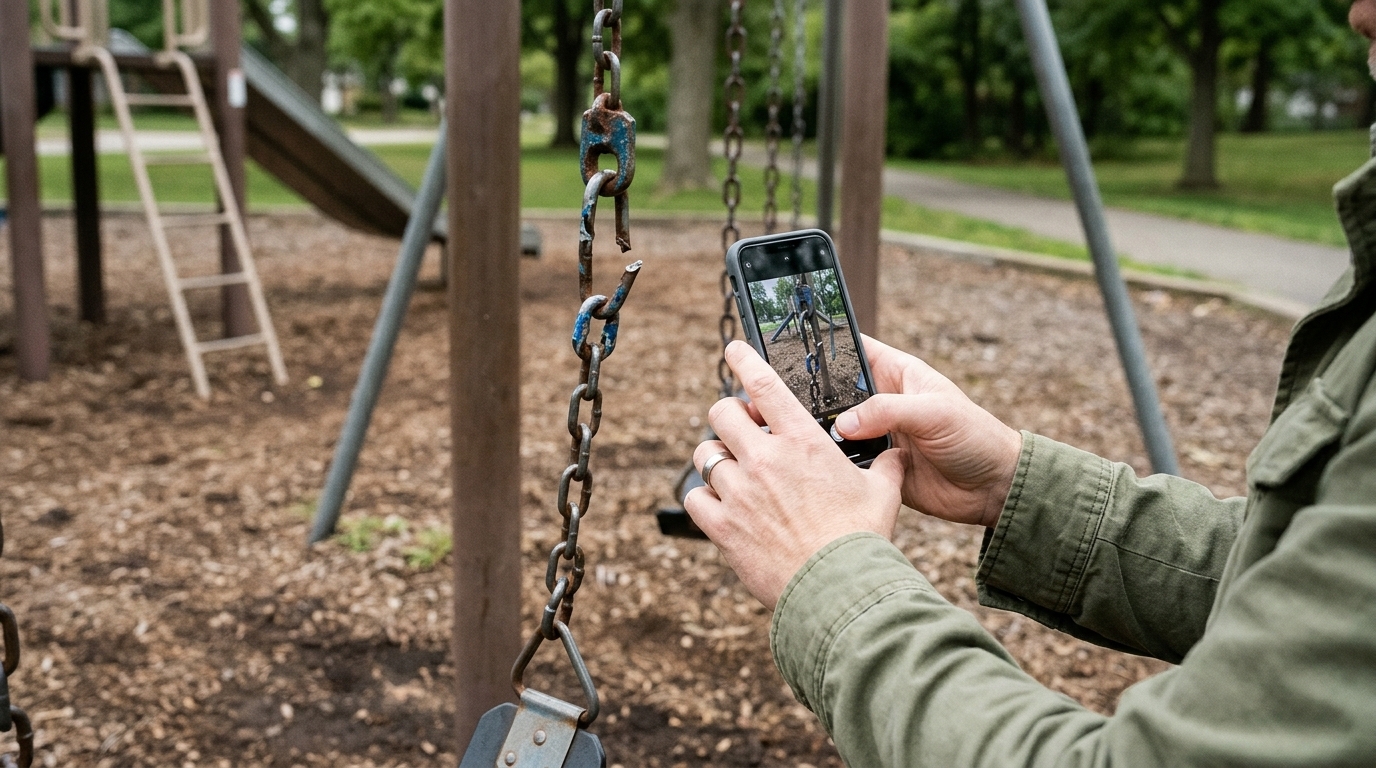
In the moments after your child gets hurt, the only thing that matters is your child. Once they're safe, these steps make the biggest difference to the case that follows.
- Get medical care right away, and follow up. Head injuries in particular can look minor at first. Tell the doctor exactly how the injury happened, and keep every follow-up appointment. Gaps in treatment are the first thing an insurance company points to.
- Photograph everything — that day if you can. The equipment, any broken parts, the surfacing (put a phone or shoe next to it for scale), the fall height, warning signs or the lack of them, and your child's injuries as they heal.
- Report it in writing. Notify the school, daycare, business or park office, and ask for a copy of the incident report. Remember: for a public entity, this is not the legal Notice of Tort Claim.
- Get names. Other parents, staff on duty, anyone who saw the fall or knew about the hazard beforehand.
- Save the evidence. Keep the clothing and shoes your child wore. Don't wash them.
- Keep a simple journal. Missed school, missed activities, nightmares, fear of the playground, pain on bad days. Juries understand a child's injury through these details.
- Stay off social media. Don't post about the accident or your child's recovery. Ask family to do the same.
- Don't give recorded statements or sign anything for an insurance company before talking with a lawyer. Adjusters are friendly for a reason.
- Talk to a playground injury lawyer early. A lawyer can send preservation letters so maintenance logs, inspection records and video aren't destroyed, and can bring in a certified playground safety inspector before the scene changes.
One more thing parents should know: in New Jersey, a settlement for a minor generally must be approved by a judge in a "friendly hearing," and the money is usually protected until the child turns 18. That safeguard exists for your child, and an experienced firm will walk you through it.
How Our Playground Injury Lawyers Prepare Your Child's Case
Most playground injury cases settle. But insurance companies don't settle cases fairly because they like you. They settle because they believe your lawyer is ready, willing and able to win in front of a jury. At Scura, Wigfield, Heyer, Cammarota & Gonzalez, LLP, we build every case to make that belief unavoidable.
We roundtable cases with retired judges. Before key decisions: whether to accept an offer, which experts to retain, how to answer the "where was the parent?" defense, we sit down with retired judges and walk them through the case. Judges Brogan and Chiocca always gives us great insight on these cases. These are people who have presided over hundreds of trials and watched how juries react. They tell us where the case is strong, where a defense lawyer will attack, and what a fair value really looks like. That candid, inside-the-courtroom perspective is something most firms simply don't have.
We rehearse in our own mock courtroom. Our office includes a full mock courtroom, and we use it. We practice openings and cross-examinations. We test how a jury will see the playground photos and the safety inspector's findings. And, just as important for a child's case, we use it to prepare families. Testifying is intimidating for anyone, and especially for a child. Walking into a real-looking courtroom ahead of time, sitting in the witness chair, and practicing with someone kind takes much of the fear out of it. A calm, confident child is a credible witness.
The result is simple. When we sit across the table from an insurance company, they know our case has already been tested by judges and rehearsed in a courtroom. That's leverage, and it's leverage we use for your family.
Playground Injury Law Firm Serving All of New Jersey - Free Consultations - No Attorney Fees Unless We Recover Compensation for Your Child.
Frequently Asked Questions About New Jersey Playground Injuries
Can I sue if my child was hurt on a school playground in New Jersey? Often, yes. Public schools are covered by the New Jersey Tort Claims Act, so a Notice of Tort Claim usually must be filed within 90 days. Private schools and daycares are held to ordinary negligence rules, and nonprofit schools may raise charitable immunity.
What is the most common cause of playground injuries? Falls. The CPSC has found falls and equipment failures together account for two-thirds of reported playground incidents. Inadequate surfacing under the equipment is usually what turns a fall into a serious injury.
Who is responsible when a child is injured at a playground? It depends on the facts. Possible defendants include the property owner, the company that built or installed the equipment, and the school, daycare or camp supervising the child.
Does New Jersey have playground safety laws? Yes. The Playground Safety Subcode (N.J.A.C. 5:23-11) makes the CPSC's Public Playground Safety Handbook mandatory for public, nonprofit and commercial playgrounds in New Jersey.
How long do I have to file a playground injury claim for my child in New Jersey? A child's own claim generally runs until two years after their 18th birthday. A parent's claim for medical bills is generally two years from the injury. Claims against public entities require notice within 90 days.
How much does a playground injury lawyer cost? Our personal injury cases are handled on a contingency fee. There's no fee unless we recover money for your child, and the consultation is free.
Talk to a New Jersey Playground Injury Attorney Today

If your child was hurt on a playground — at school, a park, a daycare, a camp or a business — you don't have to figure this out alone. Call Scura, Wigfield, Heyer, Cammarota & Gonzalez, LLP at (973) 786-1582 for a free, no-pressure consultation. We'll tell you honestly whether you have a case, which deadlines apply, and what we'd do next.
Helpful Resources for Parents
- Public Playground Safety Handbook, 2025 edition — National Program for Playground Safety (playgroundsafety.org), hosting the CPSC's latest handbook
- Playground Safety Subcode — New Jersey Department of Community Affairs (nj.gov)
- Nonfatal Playground-Related Traumatic Brain Injuries Among Children, 2001–2013 — Centers for Disease Control and Prevention (cdc.gov)
- Injuries and Deaths Associated with Children's Playground Equipment — U.S. Consumer Product Safety Commission (cpsc.gov)
- Model Jury Charge 8.70: Tort Claims Act Threshold — New Jersey Courts (njcourts.gov)