
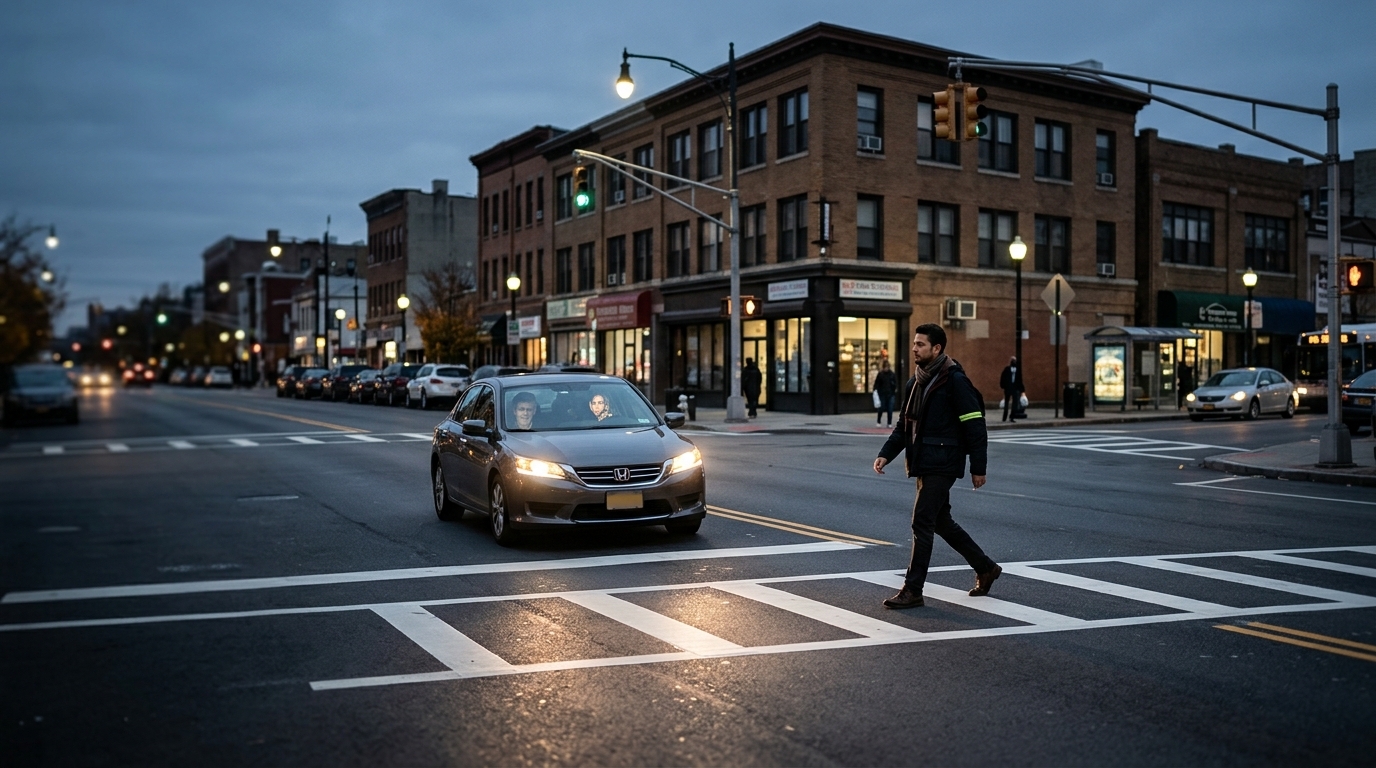
Clocks fall back in early November, and for the next several months, the evening commute in New Jersey happens in the dark. That shift matters more than it might seem. A driver who is used to seeing pedestrians clearly at 5:30 p.m. in July is suddenly navigating the same streets and the same crosswalks in near-darkness. If you walk, jog, or wait for a bus anywhere in Wayne, Hackensack, Newark, Secaucus, or Clifton, it is worth understanding exactly what New Jersey law requires of drivers, and of pedestrians, at a crosswalk.
Our firm represents many clients in Newark, Jersey City and Hoboken, which are walking and congested cities in NJ. This hyper congestion leads to more pedestrian accidents.
This post breaks down the core legal rules that govern pedestrian accidents in New Jersey, explains how fault gets analyzed when a driver and a pedestrian disagree about what happened, and outlines what to do if you or someone you love is hurt.
What New Jersey Law Requires of Drivers at a Crosswalk
New Jersey's crosswalk statute, N.J.S.A. 39:4-36, is the starting point for almost every pedestrian accident case in the state. Under that law, a driver must yield the right of way to a pedestrian crossing within a marked crosswalk, or within an unmarked crosswalk at an intersection. The duty is not just to slow down. According to New Jersey's model civil jury charge interpreting the statute, a driver must stop and remain stopped to allow a pedestrian to cross when that pedestrian is on the roadway or within one lane of the half of the roadway on which the vehicle is traveling.
You can read the full language of the charge, which New Jersey judges read to juries in these cases, in the New Jersey Courts' model civil jury charge on duties at crosswalks. It is denser reading than a typical blog post, but it is the actual legal standard a jury would apply.
What New Jersey Law Requires of Pedestrians
Pedestrians have obligations too, though the law frames them narrowly. A pedestrian may not leave a curb or other place of safety and walk or run into the path of a vehicle that is so close it is impossible for the driver to yield or stop in time. Outside of marked or unmarked intersection crosswalks, a pedestrian crossing the roadway generally must yield to approaching vehicles. At signalized intersections, pedestrians are expected to obey the pedestrian signal and use the marked crosswalk.
New Jersey's Division of Highway Traffic Safety has summarized the practical side of this, including the penalties involved: a driver who fails to stop for a pedestrian in a marked crosswalk can face a $200 fine, up to fifteen days of community service, insurance surcharges, and two points on their license, while a pedestrian who violates crossing rules can face a $54 fine. Half of the fines collected from drivers fund the state's Pedestrian Safety Enforcement and Education program. You can see this laid out in the New Jersey Office of the Attorney General's crosswalk safety guidance.
The "Permissive Inference" That Can Matter in a Pedestrian's Case
One detail in the model jury charge is particularly important for anyone hurt while crossing the street. When a collision happens within a marked crosswalk, or within an unmarked crosswalk at an intersection, the charge allows the jury to draw a permissive inference that the driver did not exercise due care for the pedestrian's safety. That does not automatically win a case. It means a jury is permitted, though not required, to treat the fact of the crosswalk collision itself as some evidence that the driver fell short of the duty of care. In practice, this inference can matter a great deal when the facts of exactly what happened are disputed.
How Comparative Fault Plays Into a Pedestrian Accident Claim
New Jersey follows a modified comparative negligence approach in personal injury cases, including pedestrian accidents. In general terms, an injured pedestrian can still recover compensation even if they were partly at fault for the accident, so long as their share of the fault does not exceed the other party's share. Any amount recovered is reduced by the pedestrian's own percentage of fault. This means that even a pedestrian who was not perfectly compliant with the letter of the crossing rules, for example someone who stepped off the curb a moment early, is not automatically barred from a claim. Fault is typically assessed based on the specific facts: lighting, signal timing, vehicle speed, and the positions of both the driver and the pedestrian in the moments before impact.
Why Fall and Early Winter Bring More Pedestrian Risk
Federal transportation safety data has long shown that pedestrian crashes are not evenly distributed throughout the day. In one federal review of Halloween-season crash patterns, nearly a quarter of pedestrian fatalities nationally occurred between 4:00 and 8:00 p.m., and roughly another third occurred between 8:00 p.m. and midnight, with the majority of pedestrian deaths happening after dark. That pattern is exactly why the switch back to standard time in early November is worth paying attention to: it pushes the ordinary evening commute, school pickup, and dog-walking routine directly into the window when visibility is worst and drivers are least prepared for it.
None of this shifts the legal duties described above. A driver is still required to watch for and yield to pedestrians regardless of how dark it is outside. But from a practical safety standpoint, pedestrians in New Jersey should expect reduced driver reaction time during these months, use crosswalks and signals even on short crossings, and consider reflective clothing, especially with Halloween trick-or-treating season and early winter darkness arriving together this year.
What Happens If You Are Hit by a Car While Walking in New Jersey
New Jersey is a no-fault auto insurance state, which means your initial medical treatment after being hit as a pedestrian is typically paid through personal injury protection, or PIP, coverage, up to your policy's limits, regardless of who caused the crash. PIP can come from your own auto policy if you have one, a resident relative's policy, or in some situations through the vehicle that struck you.
Once PIP benefits are addressed, a separate claim against the at-fault driver can cover pain and suffering and losses that exceed PIP coverage, subject to New Jersey's comparative negligence rules described above. If the accident happened because of a dangerous intersection, a malfunctioning signal, or a poorly maintained municipal sidewalk, claims against a government entity involve a short and strict notice deadline that is very different from, and much faster than, the deadline for an ordinary claim against a private driver. That is one of the most important reasons not to wait before talking to an attorney if a public road, sidewalk, or signal may have contributed to the accident.
Steps to Protect Your Claim After a Pedestrian Accident
Seek medical attention right away, even if you feel capable of walking away from the scene. Call the police so an official crash report is created. Get the names and contact information of any witnesses, and if you are able, take photographs of the crosswalk, the signal, lighting conditions, and any vehicle involved. Avoid giving a recorded statement to an insurance company before speaking with an attorney, since early statements are sometimes used later to argue that a pedestrian shared more fault than they actually did. And if a municipal or state entity may be partly responsible, do not delay in getting legal advice given how short those notice deadlines can be. Our New Jersey pedestrian accident attorneys regularly help injured pedestrians sort through exactly these issues, from identifying every available source of coverage to meeting strict notice deadlines when a public entity is involved.
Frequently Asked Questions
- Who is at fault if a pedestrian is hit outside of a crosswalk?
- Fault depends on the specific facts. New Jersey law requires pedestrians crossing outside a marked or unmarked intersection crosswalk to yield to approaching vehicles, but drivers still have a general duty to drive carefully and watch for pedestrians. A pedestrian struck outside a crosswalk may share some fault, but that does not automatically mean the driver is free of responsibility.
- Does crossing outside a crosswalk automatically bar my claim?
- No. New Jersey's modified comparative negligence rule allows an injured person to recover damages, reduced by their own percentage of fault, as long as that percentage does not exceed the other party's share of fault. It is not an automatic bar.
- Will my own car insurance pay my medical bills if I am hit as a pedestrian?
- In many cases, yes. New Jersey's no-fault system generally means personal injury protection coverage, often your own auto policy or a household member's, pays initial medical expenses regardless of fault, up to the policy's limits.
- What if the crosswalk, signal, or sidewalk itself was dangerous or poorly maintained?
- Claims involving a dangerous condition on government property, such as a municipal road, sidewalk, or traffic signal, involve a short, strict notice deadline that is very different from a standard injury claim against a private driver. Speak with an attorney as soon as possible if a public entity may share responsibility.
- Does a driver always get the benefit of the doubt in a crosswalk crash?
- No. New Jersey's model jury charge allows a jury to draw a permissive inference that a driver did not use due care when a crash happens within a marked crosswalk or an unmarked crosswalk at an intersection. This can work in an injured pedestrian's favor, though it is not an automatic finding of fault.


