
New Jersey had a genuinely good year on its roads in 2025, at least by the numbers. Traffic fatalities dropped by about 15%, falling from 684 deaths in 2024 to 582 in 2025, according to the New Jersey Attorney General's Office. Fatal crashes themselves fell by roughly 16%, from 647 to 547. Attorney General Matthew Platkin called it "a clear step in the right direction," while also noting that "even one traffic fatality is one too many."
That's a meaningful improvement, and it's worth acknowledging. But a drop in fatalities doesn't mean a drop in car accidents, and it definitely doesn't mean fewer people are getting hurt on New Jersey roads. If you or someone you love is dealing with the aftermath of a crash right now, here's what the latest data actually shows, and more importantly, what you need to know about protecting your legal rights afterward.
What we are noticing as attorneys in NJ is that distracted driving is still a major cause for accidents.
The 2025 Numbers, County by County
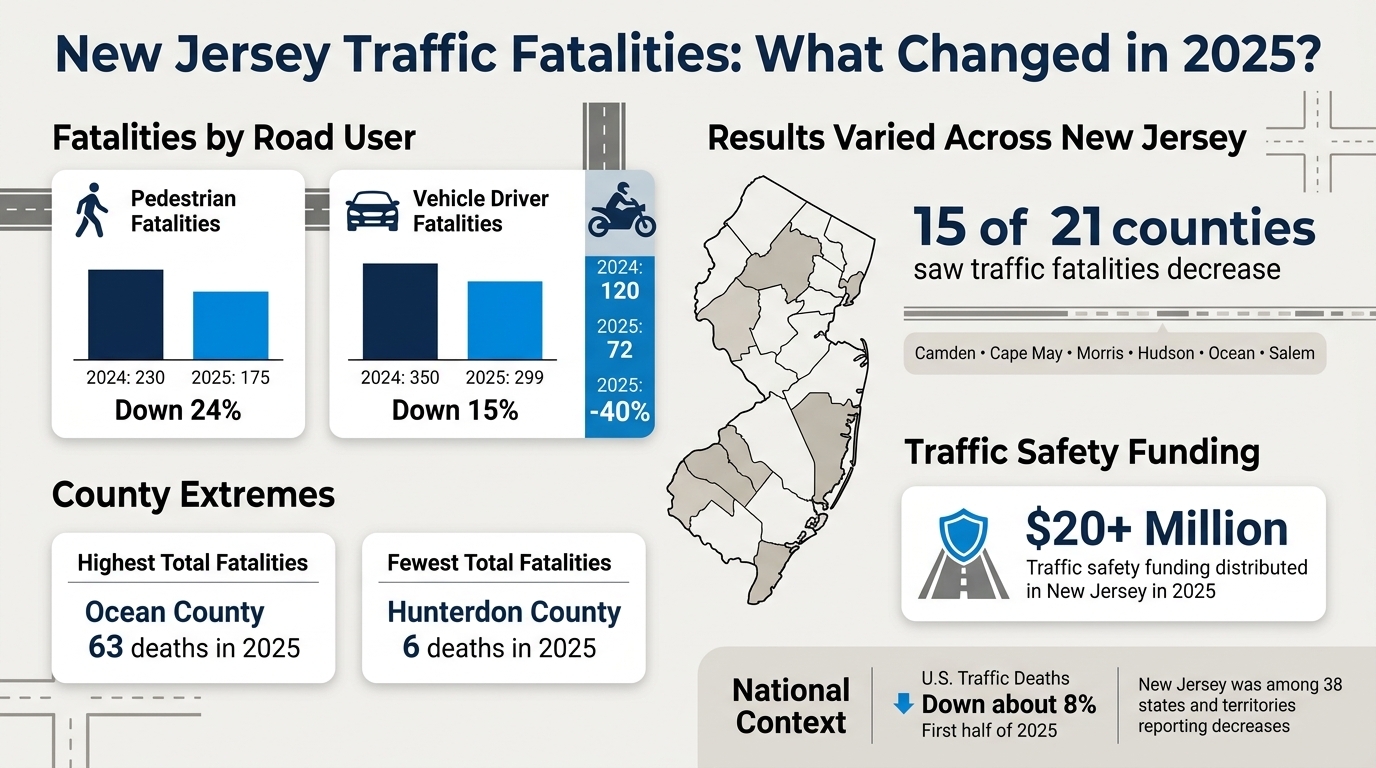
The declines weren't limited to overall fatalities. Pedestrian deaths fell nearly 24%, from 230 in 2024 to 175 in 2025. Deaths among vehicle drivers dropped about 15%, from 350 to 299. Motorcyclist fatalities saw the steepest decline of any category, down about 40%, from 120 to 72.
The improvement wasn't uniform across the state, though. Fifteen of New Jersey's 21 counties saw fatalities decrease, but six, Camden, Cape May, Morris, Hudson, Ocean, and Salem, actually saw increases. Ocean County recorded the most traffic deaths of any county in 2025, with 63, while Hunterdon County recorded the fewest, with 6. The state also credited more than $20 million in traffic safety funding distributed in 2025, and pointed to national data showing U.S. traffic deaths fell about 8% in the first half of 2025, with New Jersey among 38 states and territories reporting decreases.
You can read the full announcement from the New Jersey Office of the Attorney General, including comments from Division of Highway Traffic Safety Director Michael J. Rizol Jr.
Why the Decline Doesn't Mean Fewer Injury Claims
Fatal crashes, even at 2024's higher numbers, have always represented a small fraction of total collisions on New Jersey roads. The overwhelming majority of accidents involve property damage and injuries rather than deaths, and none of the figures above tell us anything about how many people were hurt badly enough to need surgery, physical therapy, or months away from work. A safer year for fatalities doesn't necessarily translate into a safer year for the thousands of drivers, passengers, cyclists, and pedestrians who get injured and then have to deal with insurance adjusters, medical bills, and lost income while they recover.
Distracted driving, aggressive driving, and impaired driving remain persistent problems on New Jersey roads even as fatality numbers move in the right direction. If you're injured in a crash, the encouraging statewide trend doesn't change what you need to do next.
If You're Injured in a New Jersey Car Accident
New Jersey is a no-fault insurance state, which means your own Personal Injury Protection, or PIP, coverage generally pays your initial medical bills after a crash regardless of who caused it. That coverage exists specifically so injured people aren't left waiting on a liability determination before they can see a doctor.
Depending on the type of policy you carry, New Jersey law may also limit your ability to sue the at-fault driver for pain and suffering unless your injuries meet certain legal thresholds. We've written in more detail about how no-fault PIP coverage interacts with at-fault liability claims in New Jersey, which is worth a read if you're trying to understand how the two systems fit together after a crash.
The Deadline Most People Don't Know About: Claims Against the Government
One detail that catches a lot of accident victims off guard involves crashes connected to a public entity, whether that's a pothole or malfunctioning traffic signal maintained by a county or municipality, a collision with a police car, school bus, or public works vehicle, or an accident tied to dangerous road design on a state or local roadway.
Under New Jersey's Tort Claims Act, claims against public entities carry a strict 90-day notice requirement. According to the New Jersey Department of the Treasury, you generally must file a formal notice of claim within 90 days from the date of the accident, or from the date you discovered the injury, in order to preserve your right to pursue a claim. Miss that window, and you don't automatically lose your case, but you do have to file a motion asking a court for permission to submit a late claim, and there's no guarantee that permission will be granted.
You can find the state's official notice of claim requirements through the New Jersey Division of Risk Management, which administers claims filed against the state and its agencies.
This 90-day deadline is far shorter than the general filing window for most personal injury lawsuits in New Jersey, which is one of the biggest reasons it's worth talking to an attorney quickly after any accident that might involve a government vehicle, road, or property, rather than waiting to see how your injuries progress.
How an Insurance Claim Typically Unfolds
After a crash, your own PIP carrier will usually open a claim to start paying qualifying medical expenses, subject to the limits and terms of your policy. If your injuries are more serious, or if a claim moves toward a potential lawsuit against an at-fault driver, don't be surprised if an insurance company asks for an examination under oath or requests extensive medical records. Insurers are businesses, and their adjusters are evaluating how much the claim is worth to them, not necessarily what's fair to you. That's true whether you're dealing with your own carrier or the other driver's.
Property damage claims typically move on a separate track from injury claims, and it's common for a vehicle to be repaired or a total loss settled well before the medical side of a claim is anywhere close to resolved. Rushing to settle an injury claim before you know the full extent of your treatment is one of the more common mistakes accident victims make, since a signed release usually closes the door on asking for more money later, even if it turns out you needed additional surgery or therapy.
Practical Steps After an Accident in New Jersey
- Call the police and get an official crash report, even for a seemingly minor collision.
- Seek medical attention promptly, even if you feel fine at the scene. Some injuries, especially soft tissue and head injuries, don't show symptoms right away.
- Document the scene with photos, and get contact and insurance information from everyone involved.
- Notify your own insurance company promptly, but be cautious about giving a recorded statement to the other driver's insurer before you understand your rights.
- Keep records of every medical visit, bill, and day of work missed. These become the backbone of any claim.
- Talk to an attorney promptly if a government vehicle or public road defect was involved, or if your injuries are serious, given how quickly some deadlines apply.
Frequently Asked Questions
- How long do I have to file a personal injury lawsuit in New Jersey?
- New Jersey law sets a limited window for filing most personal injury lawsuits, and if a public entity was involved, a much shorter 90-day notice deadline applies before you can pursue a claim at all. Because these deadlines depend on the specific facts of your case and missing one can permanently bar your claim, it's best to speak with an attorney as soon as possible after an accident rather than wait.
- What if my accident involved a pothole or a government vehicle?
- Claims against public entities in New Jersey, including counties, municipalities, and the state, are governed by the Tort Claims Act and generally require a formal notice of claim within 90 days of the accident. This is much stricter than the timeline for a typical claim against a private driver, so acting quickly matters.
- Does New Jersey's no-fault law mean I can't sue the other driver?
- Not necessarily. PIP coverage pays your initial medical bills regardless of fault, but depending on the type of auto insurance policy you carry, you may still be able to pursue the at-fault driver for pain and suffering if your injuries meet certain legal thresholds. An attorney can review your policy to explain whether that limitation applies to you.
- Were traffic deaths really down everywhere in New Jersey in 2025?
- No. While 15 of the state's 21 counties saw fatalities decrease in 2025, six counties, Camden, Cape May, Morris, Hudson, Ocean, and Salem, saw increases. Ocean County had the highest total fatalities in the state.
- Is this article legal advice?
- No. This article provides general information about New Jersey law and recent traffic safety data. It isn't legal advice, and outcomes depend on the specific facts of your situation. Consult a licensed New Jersey attorney about your individual case.
Conclusion
New Jersey's roads got a little safer in 2025, and that's worth being glad about. But if you're one of the thousands of people who still got hurt in a crash this year, the encouraging statewide trend doesn't pay your medical bills or protect your legal deadlines. An experienced New Jersey personal injury attorney can help you understand what steps to take next, particularly if a government entity may be involved. Please reach out to one of our NJ attorneys to discuss your case. We offer a free consultation.


