
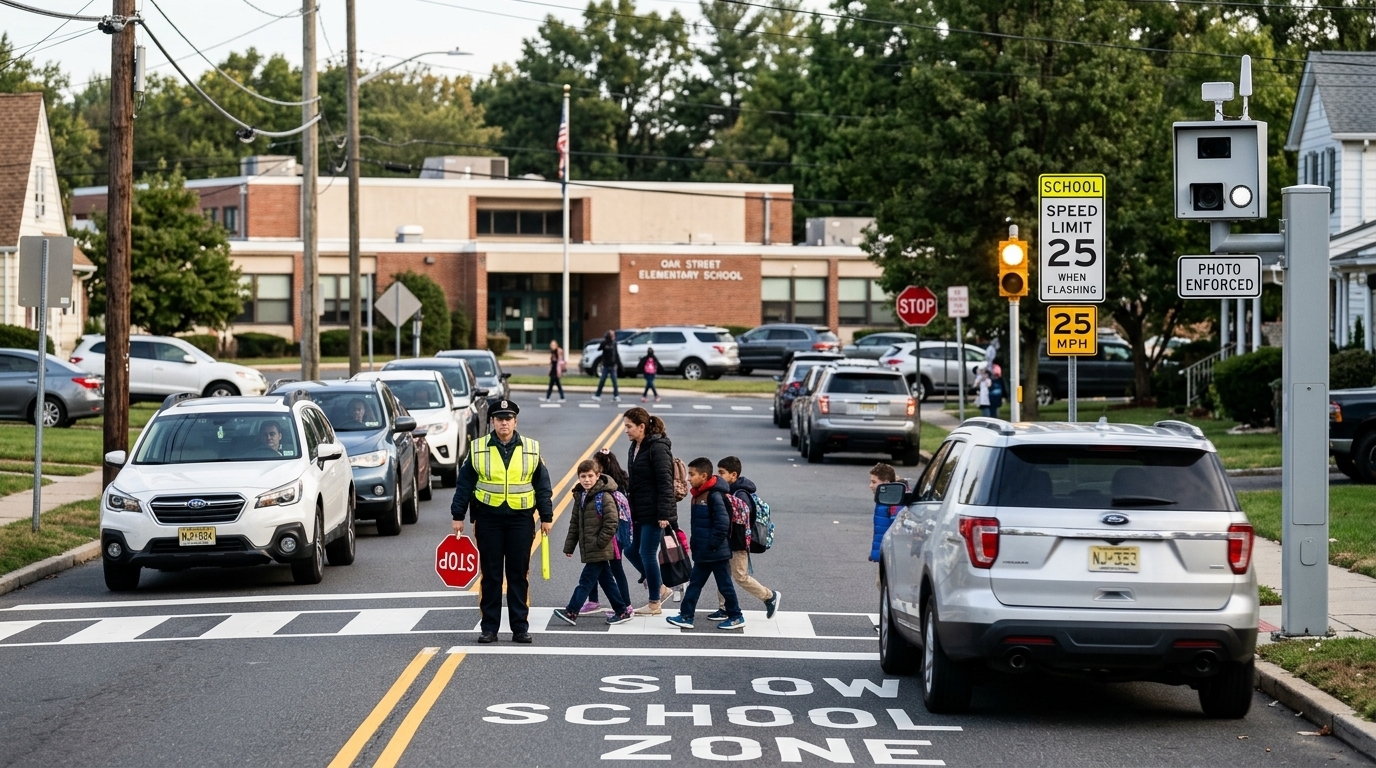
A few weeks into the school year, with buses running again and crossing guards back on their corners, New Jersey lawmakers are pushing a bill that would let towns and counties install automated speed cameras in school zones. Senate Bill S3218, the School Zone Automated Speed Enforcement and Safety Act, was introduced on January 28, 2026, and has picked up momentum through the spring and summer. It has not passed yet, but if it does, it would give municipalities a tool New Jersey does not currently authorize: cameras that can catch and ticket speeding drivers near schools without an officer present. Here's what the bill would actually do, and just as important, what New Jersey law already says about pedestrian and car accident claims whether or not this bill ever reaches the Governor's desk.
What the Proposed Law Would Actually Authorize
S3218 doesn't hand a camera to every intersection in the state. It sets up a fairly specific, opt-in framework that local governments would have to affirmatively choose to use.
Getting a Camera Installed
A municipality or county first has to adopt a resolution or ordinance at a public meeting, and it has to be backed by a traffic engineering and speed study documenting a real safety problem near that school, meaning evidence of high pedestrian traffic combined with a documented history of speeding violations or crashes. This isn't a rubber stamp; local governments have to show their work before a camera goes in.
When and How Enforcement Would Work
Under the bill, cameras could only operate Monday through Friday, from 7:00 a.m. to 4:00 p.m., and only in defined school zones marked with signage that meets federal highway standards, along with a flashing beacon showing when the system is active. A driver only gets a summons for going at least 10 miles per hour over the posted limit, and every installation comes with a 60-day warning period before real fines start.
What a Violation Would Cost, and What It Wouldn't Do
The maximum fine is $75 per violation, with court-ordered payment plans and reductions available for drivers facing financial hardship. Critically, the bill specifies that these violations would not carry motor vehicle points and would not affect insurance eligibility points, which puts them in a different category from a moving violation written by an officer. The full bill text is available through the New Jersey Legislature's official bill page.
Privacy and Where the Money Would Go
The systems would capture only a license plate, speed, and the date, time, and location of a violation, with no facial recognition or biometric data, and violation records would have to be purged within 90 days of final adjudication. Every dollar collected would go into a dedicated School Zone Safety Improvement Fund, earmarked for crossing guards, signage, and other pedestrian safety upgrades rather than general revenue, and camera vendors would be barred from being paid based on how many tickets get issued. The bill also requires annual public reporting on crash data, tickets issued, and whether enforcement is falling disproportionately on lower-income neighborhoods.
Why Lawmakers Are Pushing This Now
The push for school zone cameras is happening against a backdrop of real, if not always visible, risk to kids walking or biking near schools. Nationally, the National Highway Traffic Safety Administration reports that 7,080 pedestrians were killed in traffic crashes in 2024, with more than 71,000 injured, meaning a pedestrian was struck and killed somewhere in the country roughly every 74 minutes.
A separate NHTSA study looking specifically at school-transportation-related crashes between 2013 and 2022 found that 198 school-age children died in these crashes over that decade, and pedestrians made up the largest share of them: 76 children struck and killed while walking, more than the number who died as occupants of school buses themselves. More than half of those school-age pedestrian deaths involved children between 5 and 10 years old, the age range most likely to be walking to and from elementary school. The same study found that the most dangerous hour of the day was 3:00 to 3:59 p.m., dismissal time, and that nearly three-quarters of those deaths happened away from a marked intersection or crosswalk. None of that data is specific to New Jersey, but it's exactly the pattern a school-zone camera program is designed to address.
What New Jersey Law Already Says, Whether or Not This Bill Passes
Regardless of how S3218 turns out, the law that governs an actual pedestrian or car accident claim in New Jersey doesn't depend on whether a camera caught the speeder. If a driver hits a pedestrian, a bicyclist, or another car near a school, or anywhere else, ordinary New Jersey negligence and insurance law still applies.
New Jersey follows a modified comparative negligence rule, codified at N.J.S.A. 2A:15-5.1. Under that statute, an injured person can still recover damages as long as their own share of fault doesn't exceed the fault of the person or people they're suing; if a jury or insurer decides you were more than 50 percent responsible for what happened, you're barred from recovering anything, and if you're found partially at fault but 50 percent or less, your award is reduced by your percentage of fault. That rule comes up constantly in school-zone and crosswalk cases, where an insurance adjuster may argue that a child darted out unexpectedly or that a parent wasn't adequately supervising, in an effort to shift blame away from a speeding driver.
New Jersey's no-fault auto insurance system also comes into play for car accident injuries, meaning your own Personal Injury Protection (PIP) coverage typically pays your initial medical bills regardless of who caused the crash, before any liability claim against the other driver is resolved. A pedestrian struck by a car has their own set of rules for which insurance policy responds first, and that can get complicated quickly when a child, a family car, and a stranger's vehicle are all potentially part of the picture. Because the fault and insurance analysis can shift so much based on the specific facts, this is an area where general information only goes so far, and the details of your particular accident matter.
What To Do After a School Zone or Pedestrian Accident in New Jersey
The steps that protect a claim are largely the same whether or not a camera happened to catch the driver speeding:
- Call the police and get an official crash report, even for what seems like a minor incident.
- Get names and contact information for any witnesses, including other parents, crossing guards, or school staff who saw what happened.
- Photograph the scene, including skid marks, signage, sight lines, and the vehicles involved, before conditions change.
- Seek medical attention promptly and follow through with any recommended treatment, even if injuries seem minor at first; adjusters routinely use gaps in treatment against injured people later.
- Avoid giving a recorded statement to an insurance adjuster before speaking with an attorney, particularly if fault is contested.
If your child, or you, has been hurt as a pedestrian in New Jersey, our pedestrian accident attorneys can walk you through how comparative negligence and insurance coverage are likely to apply to your specific situation.
Please call one of our NJ personal injury attorneys if you are involved in an accident. We offer a free phone consultation. In a personal injury case, we do not charge a fee if no money is recovered.
Frequently Asked Questions
- Are speed cameras currently legal in New Jersey?
- New Jersey does not currently have a state law authorizing automated speed enforcement cameras in school zones. S3218 would create that authority for the first time, but it had not been enacted as of this writing.
- How much would a ticket cost under the proposed school zone camera law?
- The bill caps fines at $75 per violation, with reduced fines or payment plans available for drivers who show financial hardship, and a violation would only be issued for speeds at least 10 miles per hour over the posted limit.
- Would a school zone camera ticket affect my driving record or insurance?
- Under the bill as written, no. It specifically states that these violations would not result in motor vehicle points or affect insurance eligibility points.
- Does New Jersey use comparative negligence in pedestrian or car accident cases?
- Yes. Under N.J.S.A. 2A:15-5.1, an injured person can recover damages as long as their share of fault is 50 percent or less, with the award reduced by their percentage of fault. Fault above 50 percent bars recovery entirely.
- My child was hit by a car near their school. What should I do first?
- Get medical attention immediately, make sure police respond and generate a report, gather contact information for witnesses, and talk with a personal injury attorney before giving a recorded statement to any insurance company.
- When could New Jersey's school zone camera law take effect?
- If enacted, the bill specifies an effective date 180 days after signing, and the program would expire after five years unless the Legislature reauthorizes it. As of this writing, the bill has not been signed into law.


