
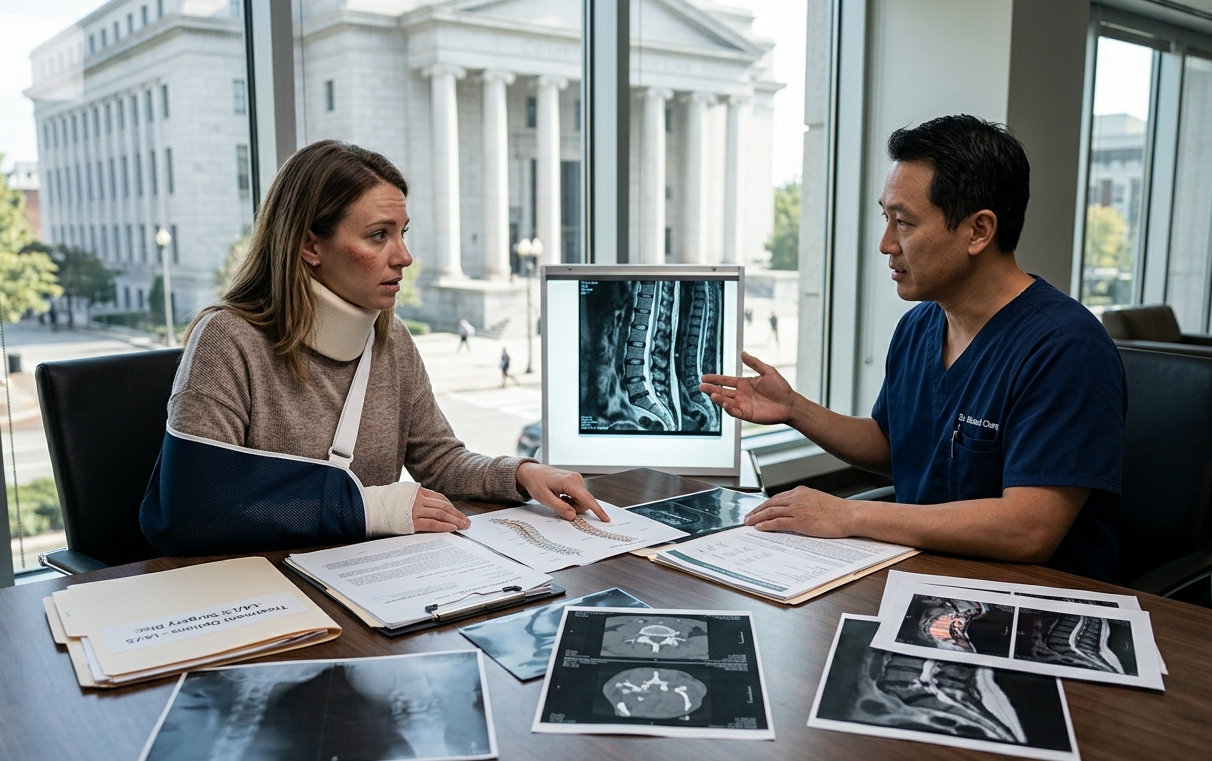
When someone is seriously injured in a New Jersey car accident, the medical bills often do not stop when the lawsuit begins. Surgery may be recommended months or years after the crash. Treatment may be delayed because of pain, uncertainty, insurance disputes, or the injured person’s understandable hesitation to undergo an invasive procedure. In many personal injury cases, those future medical needs become an important part of the damages claim.
But the New Jersey Supreme Court has now drawn a clear line in automobile injury litigation: if the injured person’s projected future medical expenses fall within available personal injury protection (also known as “PIP”) coverage limits, those expenses cannot be presented to the jury in the bodily injury case against the at-fault driver.
In Lakita D. Murray v. Christopher B. Punina and Anthony Marrone, II, decided May 6, 2026, the New Jersey Court held that future medical expenses that do not exceed a claimant’s PIP limits are “collectible” under New Jersey’s No-Fault Act and therefore inadmissible at trial under N.J.S.A. 39:6A-12. The decision is significant because it resolves a practical and recurring issue in personal injury cases: whether medical treatment that has not yet occurred, but is expected and still within available PIP limits, may be claimed as damages against a tortfeasor.
The answer, after Murray, is no.
For injured plaintiffs, defendants, insurance carriers, and trial lawyers, the ruling has real consequences. It affects how damages are calculated, how medical experts frame opinions, how settlement demands are evaluated, and how attorneys prepare cases involving future care.
Facts of the Case
The case began with an August 2016 automobile collision. Lakita Murray was a passenger in a vehicle driven by Christopher Punina when that vehicle collided with a car driven by Anthony Marrone. Murray sustained injuries in the crash.
A key fact shaped the legal issue from the beginning: Punina’s vehicle was uninsured. Murray also did not live in a household where she or a family member had automobile insurance. Because of that, she applied for PIP benefits from the New Jersey Property-Liability Insurance Guaranty Association, known as NJPLIGA, under the Unsatisfied Claim and Judgment Fund, or UCJF.
NJPLIGA approved her application. As a result, Murray became entitled to medical expense benefits up to $250,000. By the time of trial, however, the cost of the medical treatment she had already received had not exhausted those benefits.
Murray filed a personal injury lawsuit against both drivers, Punina and Marrone. Punina defaulted and did not participate in the trial. Marrone remained in the case.
Before trial, Murray made an offer of judgment for $50,000 under New Jersey Court Rule 4:58-1. Marrone did not accept that offer. This later became important because, under New Jersey’s offer of judgment rule, a plaintiff who obtains a sufficiently favorable trial result after making an unaccepted offer may be entitled to certain fees, costs, and interest.
The central dispute concerned Murray’s future medical expenses. Her medical expert, Dr. Arthur Perry, testified in deposition that her future medical costs would likely range from $42,000 to $160,000. Those expenses were described as “future” expenses because Murray had not yet undergone the recommended treatment before trial. She testified that she wanted to have the recommended surgeries but had not yet done so.
Marrone moved before trial to exclude that portion of the expert testimony. He argued that because Murray still had available PIP benefits and because the estimated future treatment would not exceed her remaining PIP limits, the evidence was inadmissible under N.J.S.A. 39:6A-12. The trial court denied the motion.
The case proceeded to a two-day jury trial. The jury heard Dr. Perry’s testimony about Murray’s projected future medical expenses. It found Punina 80 percent responsible and Marrone 20 percent responsible for the accident. The jury awarded Murray $250,000 in non-economic damages and $100,000 for future medical expenses.
Because Marrone was found 20 percent liable, the judgment against him included $50,000 for non-economic damages and $20,000 for future medical expenses, plus prejudgment interest and costs. The trial court entered judgment against Marrone for $76,736.21 and then awarded an additional $44,107.58 under the offer of judgment rule.
Marrone moved for judgment notwithstanding the verdict, renewing his argument that the future medical expense evidence should never have gone to the jury. The trial court denied that motion.
On appeal, the Appellate Division reversed in part. It held that the future medical expense evidence was inadmissible because the expenses were “collectible” under PIP coverage. The appellate court modified the judgment to remove the future medical expense award and also removed the additional offer-of-judgment award, because the future medical expense component had been necessary to reach the threshold for those additional amounts.
The New Jersey Supreme Court granted certification and affirmed the Appellate Division.
The Legal Issue Before the New Jersey Supreme Court
The Supreme Court framed the issue directly, whether evidence of a plaintiff’s future medical expenses is admissible in a personal injury trial when those projected expenses would not exceed the plaintiff’s PIP coverage limits.
That question required the Court to interpret N.J.S.A. 39:6A-12, part of New Jersey’s Automobile Reparation Reform Act, commonly known as the No-Fault Act.
New Jersey’s no-fault automobile insurance system generally requires medical expenses from auto accidents to be handled through PIP coverage, regardless of who caused the crash. The system is intended to provide prompt payment of medical expenses while limiting certain types of litigation over economic losses.
N.J.S.A. 39:6A-12 bars evidence of amounts that are “collectible or paid” under PIP coverage in a civil action for bodily injury. In plain terms, a plaintiff generally cannot present medical bills to the jury as damages against the at-fault driver if those bills are payable through PIP.
The reason is straightforward: New Jersey law seeks to prevent double recovery. A plaintiff should not recover the same medical expense twice — once through PIP and again from the tortfeasor.
Murray argued that her case was different for two reasons.
First, she contended that her benefits were payable through the UCJF, not through a standard automobile insurance policy, and therefore N.J.S.A. 39:6A-12 should not apply.
Second, she argued that her future medical expenses had not yet been incurred. Because they were not yet “paid,” and because no bill presently existed, she maintained that they were not “collectible” under the statute and should be recoverable against Marrone.
The Supreme Court rejected both arguments.
The Court’s Analysis: UCJF PIP Benefits Are Treated Like Other PIP Benefits
The Court first addressed whether N.J.S.A. 39:6A-12 applies when the injured person receives PIP benefits through the UCJF.
The UCJF exists to provide a measure of protection to people injured by uninsured drivers who would otherwise be left without a source of recovery for benefits that would normally be available under an auto insurance policy. In Murray’s case, because Punina’s vehicle was uninsured and Murray did not have household auto coverage, the UCJF provided access to PIP medical expense benefits.
Murray argued that because the statute refers to standard, basic, and special automobile insurance policies, but does not expressly name the UCJF, the inadmissibility rule should not apply to UCJF benefits.
The Supreme Court disagreed. It read the UCJF statute and the No-Fault Act together. The Court explained that the UCJF statute applies when PIP benefits under the No-Fault Act would be payable and that the term “personal injury protection coverage” is used generally to encompass PIP benefits provided through standard, basic, and special policies.
The Court also emphasized that the UCJF was not intended to provide greater rights than ordinary PIP coverage. It was designed to provide equivalent protection — no more and no less. If Murray’s interpretation were accepted, UCJF claimants could potentially recover medical expenses from both the Fund and the tortfeasor, while claimants with ordinary PIP coverage could not. That would create an inconsistent and unfair result, giving UCJF claimants a better recovery than similarly situated insured claimants.
The Court therefore held that N.J.S.A. 39:6A-12 applies to PIP benefits available through the UCJF.
The Meaning of “Collectible” Under N.J.S.A. 39:6A-12
The heart of the decision is the Court’s interpretation of the word “collectible.”
Murray argued that future medical expenses are not collectible because they have not yet been incurred. In her view, a medical expense should not be considered collectible until the treatment occurs and a bill exists.
The Supreme Court took a different view. It held that medical expenses covered by available PIP limits are collectible because they are eligible to be paid when incurred. They may be unpaid today, but they remain legally payable through PIP when the treatment takes place.
That distinction matters. The Court explained that expenses can be unpaid and still collectible. A projected surgery that has not yet occurred is not a paid expense, but if it falls within remaining PIP coverage, it is still collectible because the PIP carrier or applicable PIP source is responsible for payment when the treatment is performed, assuming the treatment is otherwise proper and compensable.
The Court contrasted collectible expenses with uncompensated expenses. Under the current statute, medical expenses that exceed applicable PIP limits, or are otherwise unpaid or uncovered by PIP limits, may be claimed against liable parties. Those are expenses outside the protection of PIP. But where PIP remains available and the projected treatment does not exceed the applicable limits, the expense remains within the no-fault system.
The Court’s holding was clear: future medical expense benefits that are covered under a PIP policy are “collectible” and inadmissible in the bodily injury trial under N.J.S.A. 39:6A-12.
The Role of Haines v. Taft and the 2019 Legislative Amendments
The Supreme Court also placed the Murray decision within the broader history of New Jersey PIP law.
In Haines v. Taft, the Court had previously addressed whether plaintiffs could admit medical expenses that exceeded their lower PIP policy limits. At the time, the Court interpreted the statute then in effect and upheld orders prohibiting the admission of those expenses. The Court invited the Legislature to clarify its intent if it wanted a different result.
The Legislature responded in 2019 by amending N.J.S.A. 39:6A-12. The amendments overturned Haines and made clear that injured parties may recover uncompensated medical expenses not covered by applicable PIP limits. The amended statute allows recovery of medical expenses that exceed, are unpaid, or are uncovered by the injured party’s PIP limits.
Murray argued that the amended language supported admissibility of her future medical expenses. The Supreme Court disagreed. It reasoned that the amendments expanded recovery only for medical expenses outside PIP limits — not expenses still within available PIP coverage.
The Court recognized the Legislature’s intent to protect injured people whose medical expenses exceed their PIP coverage, particularly those with lower PIP limits. But it found no legislative intent to allow plaintiffs to claim expenses against a tortfeasor when those same expenses remain payable through PIP.
In other words, the 2019 amendments opened the courthouse door for uncompensated medical expenses beyond PIP limits. They did not allow plaintiffs to bypass PIP for future medical treatment that PIP remains available to cover.
Why the Court Rejected the Plaintiff’s Position
The Court was concerned that accepting Murray’s position would undermine the structure of New Jersey’s no-fault system.
If future expenses within PIP limits could be presented to the jury merely because treatment had not yet occurred, plaintiffs could increase bodily injury verdicts by delaying treatment until after trial. That would shift costs away from PIP — where the Legislature placed them — and onto tort defendants. It would also create the risk of double recovery, because the plaintiff could obtain a jury award for future treatment and still potentially seek PIP payment when the treatment later occurred.
The Court viewed that result as inconsistent with the No-Fault Act’s purpose. New Jersey’s system is designed to have PIP pay covered medical expenses up to applicable limits. Tort litigation is reserved for other recoverable damages, including pain and suffering where permitted, and medical expenses that exceed or fall outside PIP coverage.
Because Murray’s estimated future medical expenses would not exhaust her $250,000 PIP limit, the Supreme Court held that the jury should not have heard that evidence.
The Offer of Judgment Consequence
The decision also affected the offer of judgment award.
At trial, the future medical expense award helped push the judgment against Marrone above the threshold necessary for Murray to obtain additional costs and fees under Rule 4:58-2. Once the Supreme Court held that the future medical expense evidence was inadmissible, that portion of the award had to be removed.
Without that component, the additional offer-of-judgment award could not stand. The Court therefore affirmed the Appellate Division’s decision modifying the judgment and eliminating the added costs and fees awarded under the offer of judgment rule.
This part of the decision is important for lawyers evaluating settlement strategy. An inadmissible damages category cannot be used to trigger fee-shifting consequences under the offer of judgment rule. Plaintiffs and defendants alike must carefully analyze whether claimed damages are legally recoverable before relying on them in offer-of-judgment calculations.
Statute of Limitations Concerns for Future PIP Treatment
One of the arguments raised in the case was that barring future medical expense evidence could prejudice plaintiffs because PIP claims are subject to limitation periods. The concern was that an injured person might be unable to present future medical expenses at trial and later be time-barred from pursuing PIP benefits when the treatment is eventually needed.
The Supreme Court found that concern unfounded. It explained that New Jersey law recognizes protection for future medical treatment in the PIP context. Where a carrier has made PIP payments for a compensable injury and is chargeable with knowledge that the injury will probably require future treatment, the limitation period does not strictly bar a later claim brought within a reasonable time after rejection of a prompt claim for additional treatment.
The Court cited prior authority recognizing that when future treatment is contemplated and reasonably necessary, PIP claims for that future treatment are not rigidly barred simply because time has passed. This was an important part of the Court’s reasoning because it answered the concern that plaintiffs would be left without a remedy.
In practical terms, injured people and their attorneys must be diligent. Future treatment should be documented. Medical recommendations should be preserved. PIP carriers should be placed on notice when future care is reasonably expected. If treatment is later denied, the claim must be pursued promptly through the proper PIP process.
Impact on Future New Jersey Personal Injury Cases
Murray will shape New Jersey automobile injury litigation in several important ways.
First, plaintiffs’ attorneys must carefully separate medical expenses into two categories: those collectible under available PIP coverage and those outside PIP limits. Only the latter may be presented as recoverable economic damages against the tortfeasor. Future treatment is not automatically admissible simply because it has not yet occurred. The key question is whether the projected expense falls within remaining PIP coverage.
Second, medical experts must be prepared with precision. In cases involving future treatment, an expert’s opinion may still be important for proving the seriousness, permanency, and impact of the injury. But if the future treatment cost is within PIP limits, the dollar amount of that treatment may not be admissible as damages against the defendant. Lawyers will need to prepare experts to address medical necessity and prognosis without improperly introducing barred economic-loss evidence.
Third, defendants and insurers will likely rely on Murray to challenge future medical expense claims before trial. Motions in limine seeking to bar future medical expense testimony will become common where PIP benefits remain available. Defense counsel will focus on the plaintiff’s PIP limits, the amount already paid, and whether the projected treatment would exceed the remaining available benefits.
Fourth, settlement evaluations will change. A plaintiff’s pain, suffering, disability, loss of enjoyment of life, permanency, and other non-economic damages may remain substantial. But future medical costs within PIP limits cannot be counted as trial damages against the tortfeasor. Both sides must account for that distinction when valuing cases.
Fifth, the decision reinforces the importance of PIP strategy. Plaintiffs cannot treat PIP as an afterthought. The PIP claim and the bodily injury claim must be coordinated. Counsel should monitor PIP payments, remaining limits, medical necessity disputes, future treatment recommendations, and potential arbitration deadlines. A failure to manage the PIP side of the case may affect the client’s ability to obtain necessary care.
For plaintiffs, Murray is not a loss of the right to medical treatment. Rather, it clarifies where the claim belongs. If future care is within PIP limits, the route is through PIP. If medical expenses exceed or are not covered by PIP limits, they may be pursued against the responsible parties in the personal injury action.
For defendants and insurance companies, Murray provides a strong tool to prevent juries from awarding damages for medical expenses that the no-fault system assigns elsewhere. It also reinforces the statutory policy against double recovery.
For trial attorneys, the lesson is simple but critical, damages must be presented through the correct legal channel. A compelling injury case can be weakened if the plaintiff seeks damages the statute does not allow the jury to consider. Likewise, a defendant may have a strong appellate issue if future medical expenses within PIP limits are admitted over objection.
What Injured Clients Should Take Away
For accident victims, the most important takeaway is that New Jersey’s auto insurance system is technical. The fact that future surgery or treatment may be necessary does not automatically mean the cost of that treatment can be awarded by a jury in the bodily injury lawsuit. The source of payment matters.
That does not mean future medical needs are irrelevant. They may still help explain the severity of the injury, the disruption to the plaintiff’s life, and the permanency of the harm. A person facing future surgery may have a substantial pain-and-suffering claim. But the actual cost of that future treatment may be excluded if PIP remains available to pay it.
This is why early legal guidance is so important after a serious automobile accident. Injured clients need attorneys who understand not only negligence law, but also PIP coverage, UCJF claims, medical expense admissibility, expert proofs, and the strategic relationship between insurance benefits and courtroom damages.
Scura Wigfield Heyer Stevens & Cammarota LLP: Preparing Personal Injury Cases for a Changing Legal Landscape
The Murray decision is a reminder that personal injury litigation is not static. New Jersey courts continue to refine the rules governing damages, insurance benefits, admissible evidence, and trial strategy. For injured clients, that means the choice of law firm matters.
At Scura Wigfield Heyer Stevens & Cammarota LLP, personal injury cases are prepared with the understanding that success depends on both command of the law and readiness for trial. A serious injury case cannot be handled by simply gathering medical records and waiting for settlement discussions. It requires early analysis of insurance coverage, careful development of expert testimony, strategic motion practice, and a trial plan that accounts for evolving decisions like Murray.
The firm’s dedicated mock courtroom gives attorneys and clients a meaningful advantage in that process. It allows the trial team to test themes, prepare witnesses, refine openings and closings, and evaluate how complex legal issues may be presented to a jury in clear, persuasive terms. In cases where medical evidence, PIP benefits, and damages categories overlap, that preparation can make the difference between confusion and clarity.
The firm also has access to retired judges who conduct mediations, providing clients with informed and realistic opinionss in their best interests.
Scura Wigfield Heyer Stevens & Cammarota LLP also has a certified civil trial attornes on staff, reflecting a level of courtroom experience and professional recognition that is especially important in serious personal injury litigation. Certification matters because trial practice is its own discipline. Knowing how to try a case and being prepared to do so often shapes the outcome long before a jury is seated.
In light of Murray, injured plaintiffs need attorneys who know how to preserve the full value of a claim while respecting the boundaries of New Jersey’s no-fault system. That means identifying which medical expenses belong in the PIP claim, which losses may be presented to the jury, and how future treatment affects the broader claim for pain, suffering, disability, and loss of enjoyment of life.
Scura, Wigfield Heyer Stevens & Cammarota LLP remains committed to aggressively representing personal injury clients under New Jersey law as that law continues to develop. When courts clarify the rules, the firm adapts its strategy, not its commitment. Injured clients deserve lawyers who are prepared, precise, and willing to fight for the maximum recovery the law allows.


